Network Bio Q1 2023 Investor Update
Network Bio is a horizontal platform generating multi-Omic data across indications — we partner with health systems to build a family of disease-specific tissue biobanks linked to continuous EHR

I. Network’s 2023 objective
Enter legal relationships with sufficient health systems to collectively provide us a top-of-the-funnel 4,000,000 unique patient encounters per year. This enables us to run studies of choice across multiple indications simultaneously. Raise a priced-round wherein we will pilot this concept with our Network of health systems, build a product sitting on top of this derivative dataset, hire the team.
Network Bio’s goal is to become the horizontal platform layered atop a network of health systems, orchestrating capture of disease-specific tissue across a theoretically infinite number of diseases with significant unmet patient need. We coordinate biospecimen capture, define clinical data models, and house specimens in our repositories for future re-sequencing. We generate revenue commercializing cohorts to biopharma, digitizing biobanked samples in a tried-tested model (UKBB, BioVU)
A recurring question: “which initial indications will you pursue?”
pediatrics vs adult?
oncology vs non oncology?
solid-tissue vs blood?
retrospective vs prospective biobanks?
We need market feedback from biopharma & health systems to prioritize indications.
Below is an epidemiological funnel enabling study initiation across a number of potential indications. We’ve calculated 4,000,000 unique patient encounters across our system partners as the point at which we can execute most studies. We will investigate the aforementioned options by executing pilot projects of 500 patient cohorts, a benchmark we’ve index as the minimally statistically cohort.
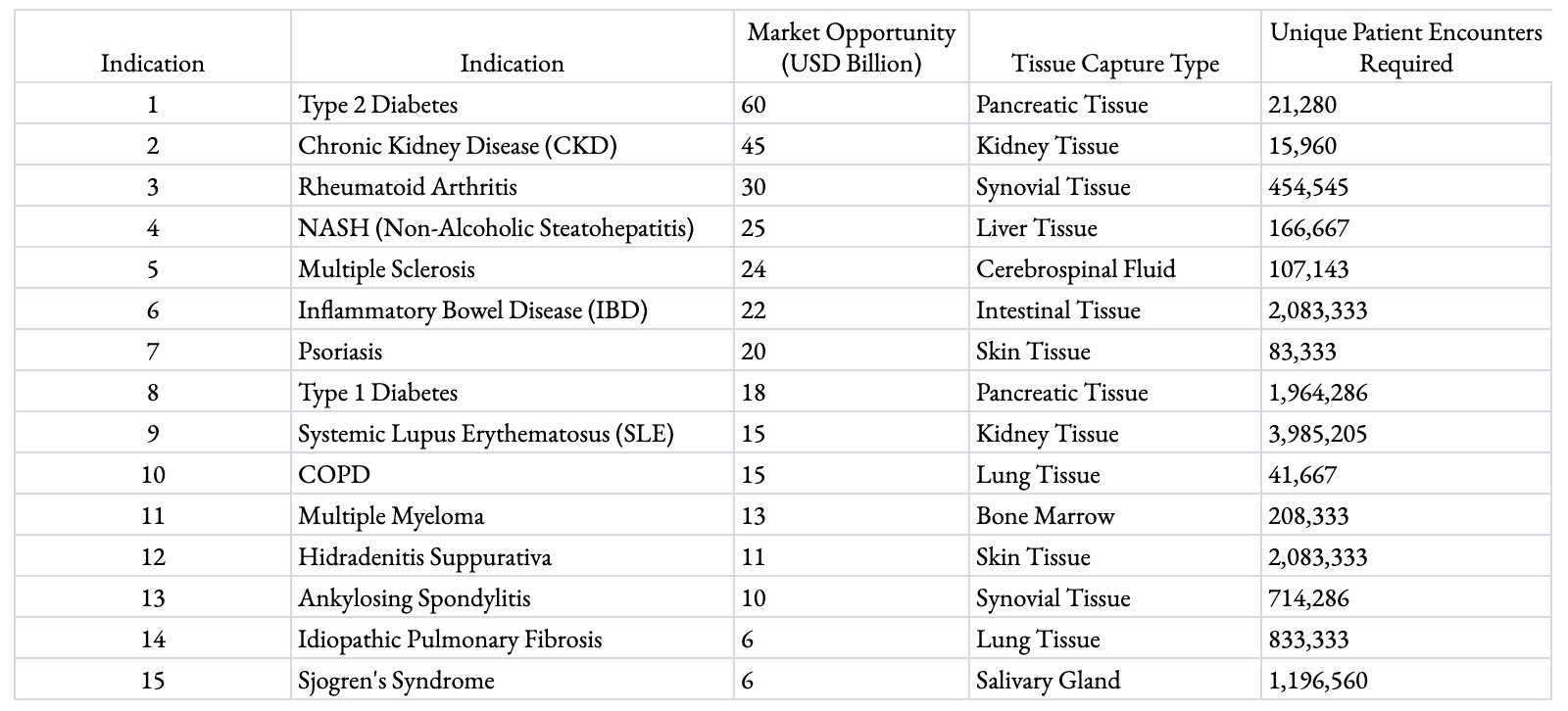
*How did we arrive at these 15 indications? A combination of discussions with leading researchers about the indications within autoimmune, nephrology, renal, cardiovascular, conditions with highest unmet medical need, biopharma investment, and the extent to which there is a genetic underpinning of the disease. Our intention is narrowing our focus during the next chapter of our company’s growth to one - two indications. Our pipeline of healthcare institutions provides us with line of sight to: pediatric instances, adult instances, disease-specific tissue, prospective capture, unlocking retrospective biobanks. We will determine how exactly to navigate the landscape with our next capital raise.
II. Network’s Supply-Side
Our business model of health system level partnerships has the following attributes:
near-zero customer acquisition cost: plane tickets, hotels, legal
access to institutions’ entire funnel of patients: Tempus has 80k solid tumor instances
non-exclusionary principles: We can collect data in Parkinson’s concurrently with SLE, type-2 diabetes & NASH
trust moats: gone are the days of trojan horsing (eg, Flatiron’s OncoEMR, Tempus’ xT). Our model is grounded in understanding health system realities: provision of patient care & historical investments of 100s of millions in enabling infrastructure
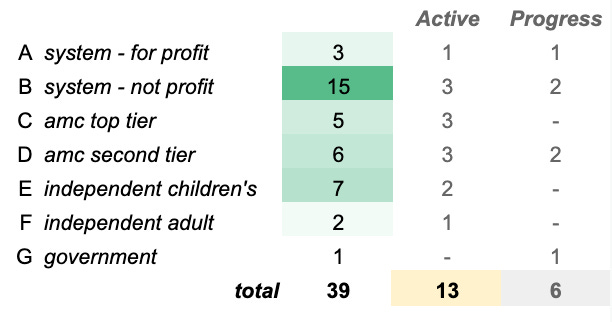
Pipeline: Starting March 27th, we began developing our health system pipeline. In 16 days, we have manifested a pipeline of nearly 40 healthcare institutions: summary statistic graphic below, full link here (link). You’ll see our view on the archetypes & as you click into the sheet, you’ll see the C-Suite seniority of audience we have engaged. Across all partners our short term goal is to run de-risked pilots with systems to build trust. Long-term our goal is develop a family of disease specific tissue banks for all “common disease” (kidney, liver, lung, brain, heart, dermatology, gut).
The health system decision-making triumvirate is CIO / CTO + star genetics researcher + business development. We have assembled this triumvirate across the following opportunities:
April 5: Tampa General (in person)
April 6: Phoenix Children’s
April 10: Cleveland Clinic
April 18: Geisinger’s MyCode biobank
April 18: NorthShore Chicago (in person)
April 19: Miami Baptist (in person)
April 21: UPMC
April 24: MUSC (in person)
April 24: Minnesota Children’s + Ventures
April 25: Temple University Health System (in person)
April 26: University Hospital Healthcare + Ventures (in person)
May 1: HCA meeting with COO Jon Foster (in person)
May 2: Frist-Cressey Ventures (in person)
III. Network’s thesis deep dive
Clinico-omic data is bucketed into two different use cases: (A) population-genomics and (B) disease-specific tissue. Network is over-indexing on disease specific tissue.
A) Population genomics is a pure play target discovery exercise that has been tackled by Regeneron <> Geisinger, Helix <> a number of health system partners. Here: one industry partner subsidizes the cost of genomic data generation of the population for one of two strategies—
traditional GWAS studies: identifying common genetic variation and matching that to phenotypes (IL23R - Crohn’s disease, TCFL2 - Type 2 diabetes)
rare variant discovery: which present in a small subset of the population that reveal loss-of-function with protective benefits in the broader population (PCSK9 - Coronary Heart Disease, KIF15 - Idiopathic Pulmonary Fibrosis).
These strategies are pursued by the genomic powerhouses such as AstraZeneca, Regeneron, Alnylam, and these datasets have been largely generated via publicly funded initiatives such as the UKBB. The commercial value on a per-patient instance and the ability to re-commercialize these data assets is questionable
B) Disease-specific tissue biobanks create tremendous value. We define these as instances of capturing the relevant tissue implicated in a given disease, enabling generation of a range of molecular data to understand disease biology. Disease specific tissue unlocks the power of multi-omics. Therein is the precision medicine flywheel thesis. Two examples:
We characterize Tempus as a disease-specific tissue biobank given their utilization of a solid tumor assay as a trojan horse into the capture of disease-specific tissue in clinical care where they generate genomic and transcriptomic data on every sample.
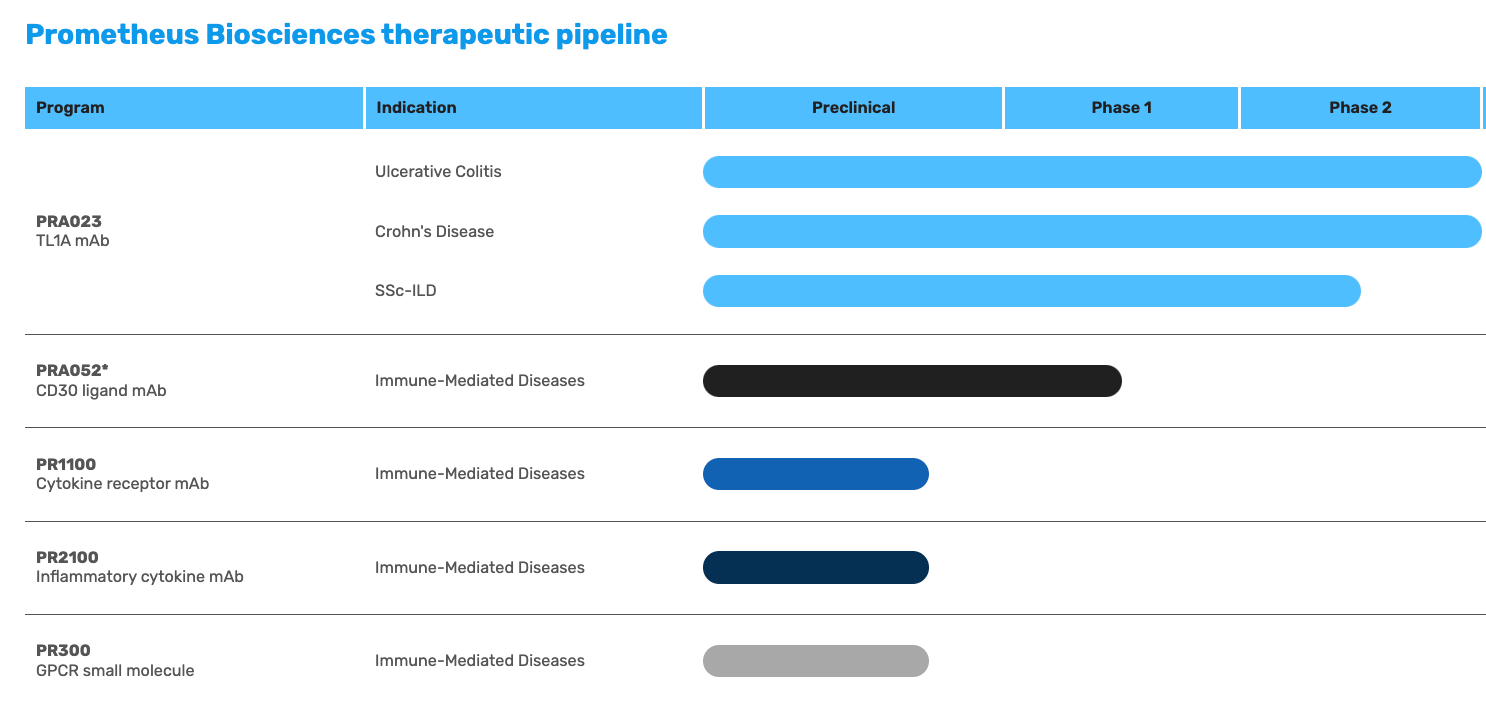
Prometheus Biosciences is a prominent example of a non-oncology biobank, a 20,000 IBD biobank with disease specific tissue capture over a 20-year timeline, which is now a $6B company
IV. Network’s infrastructure build
Our objective is to build a just-in-time network of health systems providing disease specific tissue as biopharma requests inbound.
These requests will be evaluated by a lead investigator at each site and the feasibility process will involve both the cross-referencing of the health system’s off-the-shelf biobanks as well as projections of their ability to fulfill the biopharma request from 12-month epidemiological projections. We will replicate a model successfully pioneered by TriNetX wherein industry can access a feasibility portal that executes federated feasibility criteria against a de-identified instance of the EHR and other information technology systems at their system partners. Initially, we will implement a PI-facing portal instance at our sites and install a site coordinator working with pathology departments to execute feasibility requests and shepherd demanded samples to Network Bio’s facilities.
V. Why doesn’t this exist?
Given the significant outstanding need for patients, demand from biopharma, and willingness for healthcare institutions to participate in these types of consortiums, the obvious question is why does this opportunity still exists? There are a number of ways to answer that question, but there are three that we’d like to focus on that truly illustrate the necessity of a orchestrator such as Network Bio:
A) The Epidemiological Problem: Assume you are a health system seeing 1 million unique patients per year and are interested in creating a Prometheus-like biobank in Lupus Nephritis on a 5 year timeline. Assume the minimum patient cohort necessary to build a defensible, re-licensable dataset requires a 5,000 cohort. At the end of a 5 year period, this health system individually is less than 10% of the way to this outcome. We argue this necessitates a “network-level approach”.
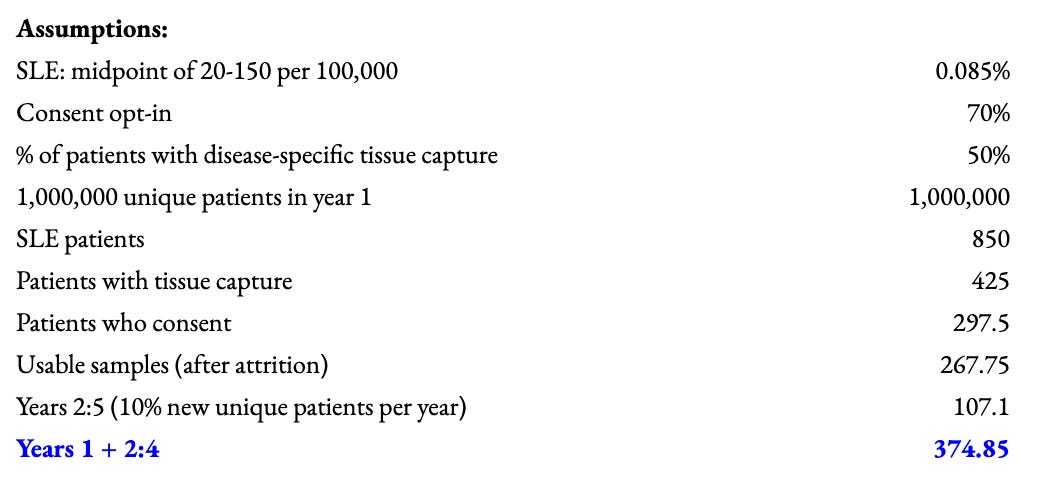
B) Supply-Demand matching and phenotypic incongruence: Given the volume of samples generated across the country, it is still questionable as to why we do not see more biobank <> biopharma transactions. As biopharma data biz dev leaders for the last several years, we have seen first-hand the extent to which biopharma’s inclusion / exclusion criteria can quickly dwindle a 1M top of the funnel cohort to only several hundred patients that are of commercial interest. Furthermore, harmonizing the clinical data model across multiple health systems or even from one health system is a significant undertaking that is best addressed by a standalone company with clinical informatics competence. We are coordinating with biopharma at time 0 to ensure cohort inclusion / exclusion criteria & clinical informatics are properly aligned.
C) Sample heterogeneity and biobanking infrastructure. Healthcare institutions are hurting financially. The median operating margin index for hospitals was -1% in January 2023, -3.7% in January of 2022. Investing in complex business development, legal negotiations, running internal biobank operations with an unclear ROI has created a climate wherein Health Systems are focused on cost cutting & internal biobanking is one of the first shoes to drop. Furthermore, heterogeneity in biobanking protocols across Health Systems has led to a degree of hesitance among biopharma to expend the time and resources required to perform quality assurance and harmonize heterogenous sample preparation protocols across health systems.
VI. Network’s thank you
Sincere thank you for your work with us front & center vs. behind-the-scenes, full time vs. advisory, formal vs. informal. It takes a village & we are developing the best.